In a few words, this market is a simplified view of the financial system.
Loanable Funds Market In Equilibrium. • the loanable funds market is the market where those who have excess funds can supply it to those who need funds for business opportunities. There is only one lending institution who charges the one interest rate (thus there are no share markets etc. The term loanable funds includes all forms of credit, such as loans, bonds, or savings deposits. In economics, the loanable funds doctrine is a theory of the market interest rate. An equilibrium real interest rate and equilibrium quantity labeled on the axis. According to this approach, the interest rate is determined by the demand for and supply of loanable funds. The supply and demand of loanable funds sets the interest rates. So, when you have equilibrium, those who want loans can get them and those who want to save will save. Stock exchanges, investment banks, mutual funds firms, and commercial banks. Which is unrealistic but a good simplification to get a base. The loanable funds market illustrates the interaction of borrowers and savers in the economy. • the loanable funds market includes: For the market of loanable funds, the supply curve is determined by the aggregate level of savings within the economy. The market becomes efficient because there isn't deviation from the equilibrium set by the supply and demand of loans. It is a variation of a market model, but what is being bought and sold is money that has been saved.
Solved: The Following Graph Shows Domestic Saving (the Gre... | Chegg.com. Stock exchanges, investment banks, mutual funds firms, and commercial banks. In economics, the loanable funds doctrine is a theory of the market interest rate. For the market of loanable funds, the supply curve is determined by the aggregate level of savings within the economy. An equilibrium real interest rate and equilibrium quantity labeled on the axis. So, when you have equilibrium, those who want loans can get them and those who want to save will save. • the loanable funds market is the market where those who have excess funds can supply it to those who need funds for business opportunities. The supply and demand of loanable funds sets the interest rates. Which is unrealistic but a good simplification to get a base. The term loanable funds includes all forms of credit, such as loans, bonds, or savings deposits. According to this approach, the interest rate is determined by the demand for and supply of loanable funds. It is a variation of a market model, but what is being bought and sold is money that has been saved. There is only one lending institution who charges the one interest rate (thus there are no share markets etc. The loanable funds market illustrates the interaction of borrowers and savers in the economy. The market becomes efficient because there isn't deviation from the equilibrium set by the supply and demand of loans. • the loanable funds market includes:
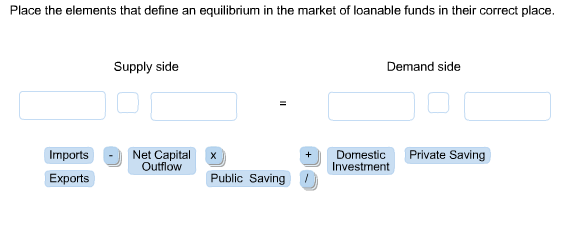
Solved: Place The Elements That Define An Equilibrium In T... | Chegg.com from d2vlcm61l7u1fs.cloudfront.net
So drawing, manipulating, and analyzing the loanable funds market isn't too difficult if you remember a few key things. There is only one lending institution who charges the one interest rate (thus there are no share markets etc. Reconciling the two interest rate models: It is a variation of a market model, but what is being bought and sold is money that has been saved. If interest rates are higher than the equilibrium where supply equals demand, there will be excess supply in the market. • the loanable funds market includes: The market for loanable funds consists of two actors, those loaning the money (savings from households like us) and those borrowing the money you can see in the above graph that the supply of loanable funds and the demand of loanable funds cross and give us an equilibrium interest rate.
The loanable funds market illustrates the interaction of borrowers and savers in the economy.
Which of the following might produce a new equilibrium interest rate of 5% and a new equilibrium quantity of loanable funds of $150? All lenders and borrowers of loanable funds are participants in the loanable. An equilibrium real interest rate and equilibrium quantity labeled on the axis. Reconciling the two interest rate models: An increase in the supply of loanable funds could result in which of the following combinations of the real interest rate and quantity of loanable funds at a new equilibrium? Real interest rate •rate of return •the laws of supply and demand explain the behavior of savers and borrowers the market d and s for loanable funds will be at equilibrium at the higher nominal interest rate. If interest rates are higher than the equilibrium where supply equals demand, there will be excess supply in the market. When government borrows money in the loanable funds market it pushes the interest rate higher, crowding out the private sector's (firm's) borrowing. So drawing, manipulating, and analyzing the loanable funds market isn't too difficult if you remember a few key things. Savings and investment are affected primarily by the interest rate. As seen in the adjacent figure, equilibrium is reached when the quantity of savings (which correspond to supply of loanable funds) equals investment and net capital outflows (demand for. In economics, the loanable funds doctrine is a theory of the market interest rate. For the market of loanable funds, the supply curve is determined by the aggregate level of savings within the economy. There is only one lending institution who charges the one interest rate (thus there are no share markets etc. • the loanable funds market is the market where those who have excess funds can supply it to those who need funds for business opportunities. With high interest rates, a lot of. Equilibrium in the loanable funds market: It is a variation of a market model, but what is being bought and sold is money that has been saved. At ie (natural rate of interest), savings = investment. The market for loanable funds is where borrowers and lenders get together. The market for loanable funds consists of two actors, those loaning the money (savings from households like us) and those borrowing the money you can see in the above graph that the supply of loanable funds and the demand of loanable funds cross and give us an equilibrium interest rate. The loanable fund theorists considered savings in two senses. A) consumers have increased consumption as a fraction of disposable income. The term loanable funds is used to describe funds that are available for borrowing. The equilibrium interest rate is determined in the loanable funds market. What changes in loanable funds supply or demand would tend to cause a shortage of funds at the current interest rate? The term loanable funds includes all forms of credit, such as loans, bonds, or savings deposits. As with other markets, there is a supply curve and a demand curve. The accompanying graph shows the market for loanable funds in equilibrium. Reconciling the two interest rate models• both the money market and the market for loanable funds are initially in equilibrium. According to this approach, the interest rate is determined by the demand for and supply of loanable funds.
Loanable Funds Market In Equilibrium : When Government Borrows Money In The Loanable Funds Market It Pushes The Interest Rate Higher, Crowding Out The Private Sector's (Firm's) Borrowing.
Loanable Funds Market In Equilibrium - Saturday Quiz - June 9, 2012 - Answers And Discussion | Bill Mitchell - Billy Blog
Loanable Funds Market In Equilibrium , The Market Becomes Efficient Because There Isn't Deviation From The Equilibrium Set By The Supply And Demand Of Loans.
Loanable Funds Market In Equilibrium : In Economics, The Loanable Funds Doctrine Is A Theory Of The Market Interest Rate.
Loanable Funds Market In Equilibrium , The Loanable Funds Market Illustrates The Interaction Of Borrowers And Savers In The Economy.
Loanable Funds Market In Equilibrium - The Market For Loanable Funds Is Where Borrowers And Lenders Get Together.
Loanable Funds Market In Equilibrium . This Causes The Supply Of Loanable Funds (Savings Curve) To Decrease And Causes A Shift Left In The Curve.
Loanable Funds Market In Equilibrium . At Ie (Natural Rate Of Interest), Savings = Investment.
Loanable Funds Market In Equilibrium , This Causes The Supply Of Loanable Funds (Savings Curve) To Decrease And Causes A Shift Left In The Curve.